Nextflow 
 

There are two ways of tracking Nextflow pipeline runs with their inputs and outputs in LaminDB.
nf-lamin
The nf-lamin Nextflow plugin works without modifying pipeline code via LaminHub’s REST API.
Option A: environment variables (no config file needed):
export LAMIN_CURRENT_INSTANCE="your-org/your-instance"
export LAMIN_API_KEY="<your-lamin-api-key>"
nextflow run -plugins nf-lamin <your-pipeline>
Option B: Nextflow secrets + config file:
Store your API key as a Nextflow secret:
nextflow secrets set LAMIN_API_KEY <your-lamin-api-key>
Create a lamin.config:
%%groovy
plugins {
  id 'nf-lamin'
}

lamin {
  instance = "your-org/your-instance"
  api_key = secrets.LAMIN_API_KEY
}
Then run your pipeline with the config:
nextflow run <your-pipeline> -c lamin.config
After the run, explore the tracked data in LaminHub or via the Python SDK:
%%python
import lamindb as ln

ln.Run.get("your-run-uid")
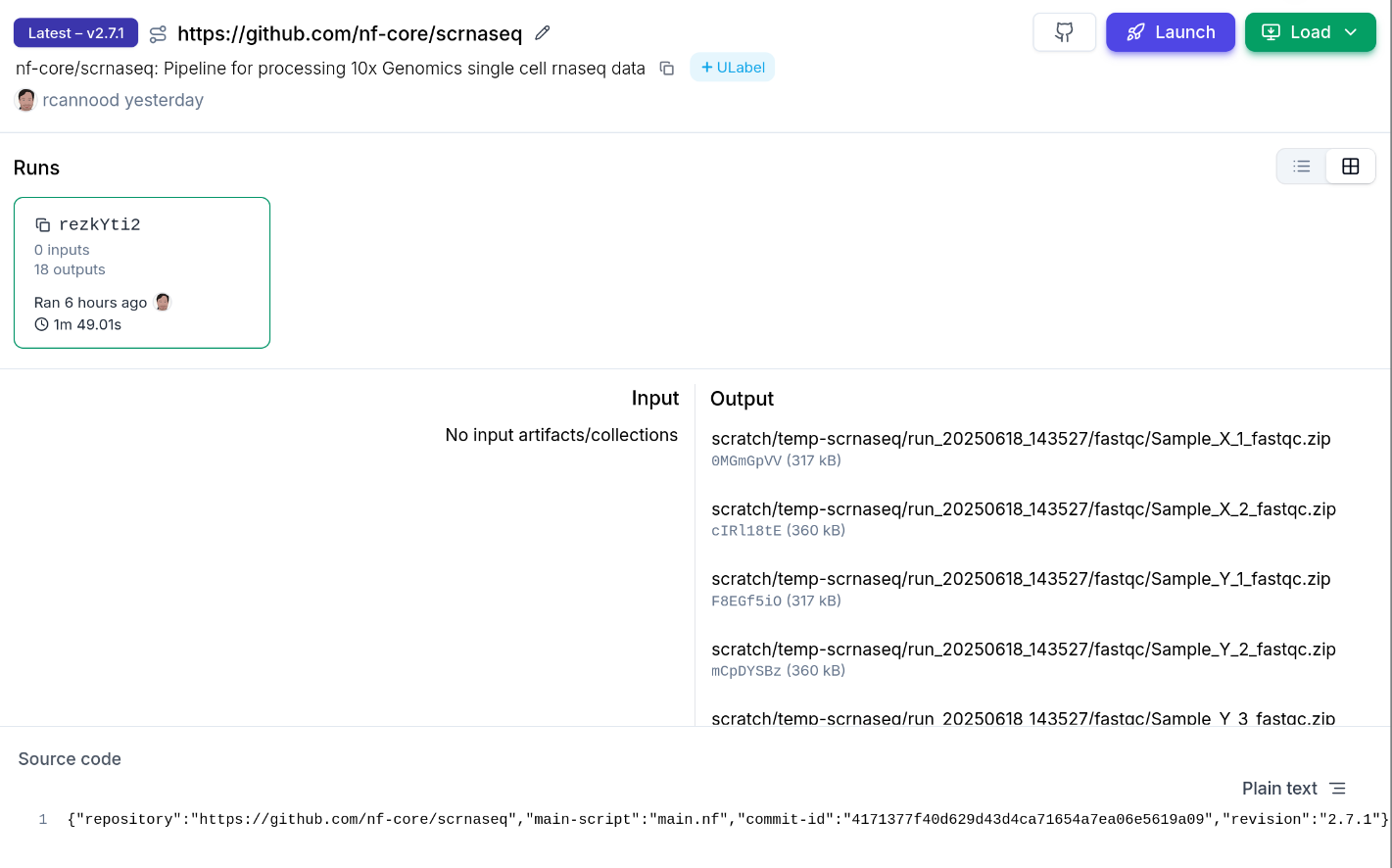
Runs executed with -with-tower or launched from Seqera Platform additionally get run.reference set
to the Platform watch URL, with run.reference_type set to "Seqera".
Publishing outputs to Lamin storage
Point the output directory at a lamin:// URI to write the outputs straight into your instance’s storage location:
nextflow run <your-pipeline> -c lamin.config -output-dir 'lamin://your-org/your-instance?prefix=results'
Or per process, with publishDir:
%%groovy
publishDir 'lamin://your-org/your-instance?prefix=results', mode: 'copy'
Each published file is registered as an artifact in place, with its path relative to the storage root as the key. Add ?space=<uid> or ?storage=<uid> to publish into a specific space or storage location.
→ See Lamin URIs for the full URI grammar.
→ See Nextflow: nf-laminfor the fullnf-lamin` configuration reference.
→ See Examples for ready-to-run examples for existing pipelines.
Post-run scripts
You can register runs manually without using the nf-lamin plugin using LaminDB in a Python post-run script. First run the pipeline:
# the test profile uses all downloaded input files as an input
nextflow run nf-core/scrnaseq -r 4.0.0 -profile docker,test -resume --outdir scrnaseq_output
Example: nf-core/scrnaseq
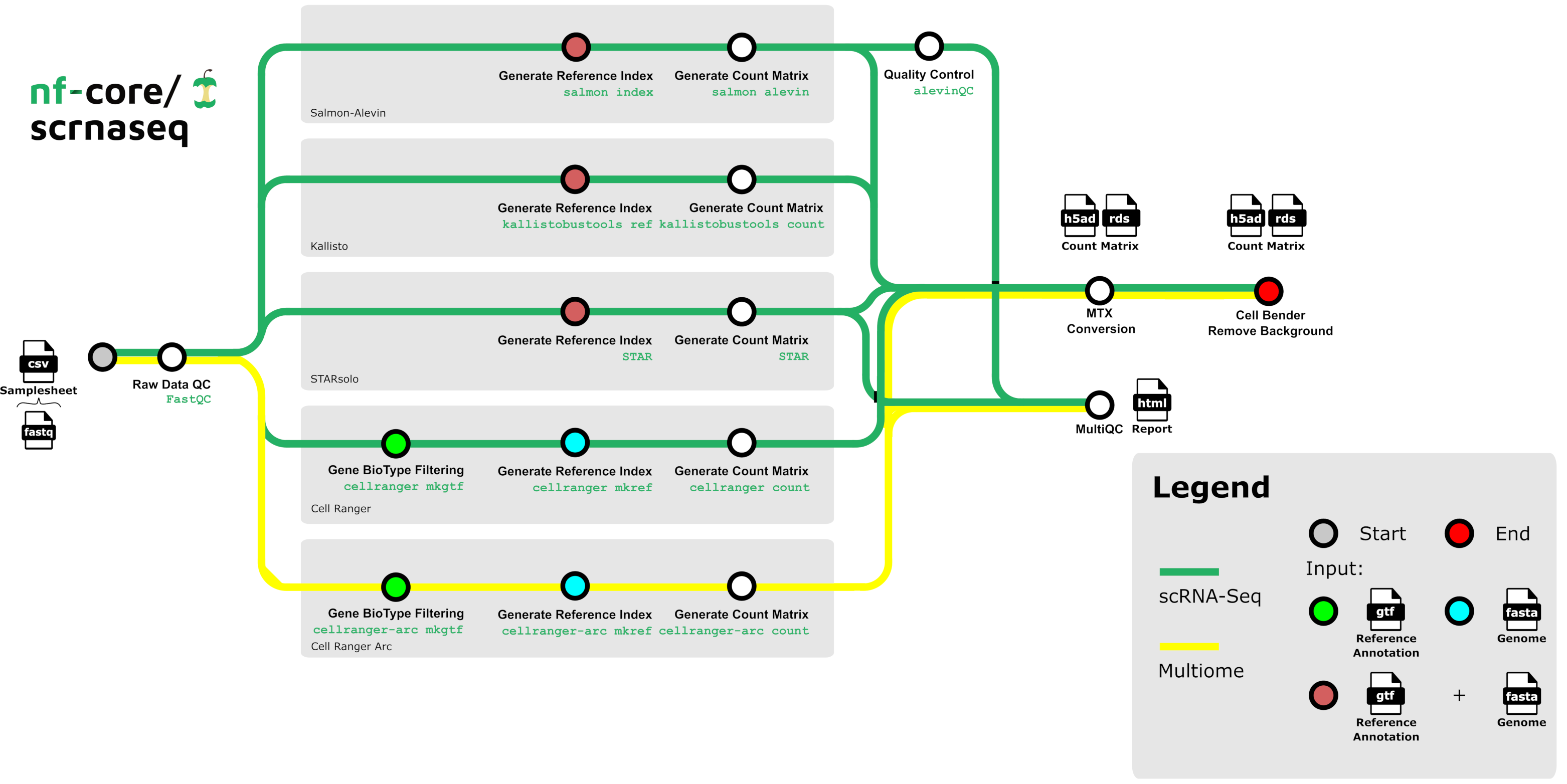
After the run is complete, use a post-run script to register inputs and outputs in LaminDB:
import argparse
import lamindb as ln
import json
import re
from pathlib import Path
from lamin_utils import logger


def parse_arguments() -> argparse.Namespace:
    parser = argparse.ArgumentParser()
    parser.add_argument("--input", type=str, required=True)
    parser.add_argument("--output", type=str, required=True)
    return parser.parse_args()


def register_pipeline_io(input_dir: str, output_dir: str, run: ln.Run) -> None:
    """Register input and output artifacts for an `nf-core/scrnaseq` run."""
    input_artifacts = ln.Artifact.from_dir(input_dir, run=False)
    ln.save(input_artifacts)
    run.input_artifacts.set(input_artifacts)
    ln.Artifact(f"{output_dir}/multiqc", description="multiqc report", run=run).save()
    ln.Artifact(
        f"{output_dir}/star/mtx_conversions/combined_filtered_matrix.h5ad",
        key="filtered_count_matrix.h5ad",
        run=run,
    ).save()


def register_pipeline_metadata(output_dir: str, run: ln.Run) -> None:
    """Register nf-core run metadata stored in the 'pipeline_info' folder."""
    ulabel = ln.ULabel(name="nextflow").save()
    run.transform.ulabels.add(ulabel)

    # nextflow run id
    content = next(Path(f"{output_dir}/pipeline_info").glob("execution_report_*.html")).read_text()
    match = re.search(r"run id \[([^\]]+)\]", content)
    nextflow_id = match.group(1) if match else ""
    run.reference = nextflow_id
    run.reference_type = "nextflow_id"

    # completed at
    completion_match = re.search(r'<span id="workflow_complete">([^<]+)</span>', content)
    if completion_match:
        from datetime import datetime

        timestamp_str = completion_match.group(1).strip()
        run.finished_at = datetime.strptime(timestamp_str, "%d-%b-%Y %H:%M:%S")

    # execution report and software versions
    for file_pattern, description, run_attr in [
        ("execution_report*", "execution report", "report"),
        ("nf_core_*_software*", "software versions", "environment"),
    ]:
        matching_files = list(Path(f"{output_dir}/pipeline_info").glob(file_pattern))
        if not matching_files:
            logger.warning(f"No files matching '{file_pattern}' in pipeline_info")
            continue

        artifact = ln.Artifact(
            matching_files[0],
            description=f"nextflow run {description} of {nextflow_id}",
            visibility=0,
            run=False,
        ).save()
        setattr(run, run_attr, artifact)

    # nextflow run parameters
    params_path = next(Path(f"{output_dir}/pipeline_info").glob("params*"))
    with params_path.open() as params_file:
        params = json.load(params_file)
    ln.Param(name="params", dtype="dict").save()
    run.features.add_values({"params": params})
    run.save()


args = parse_arguments()
scrnaseq_transform = ln.Transform(
    key="scrna-seq",
    version="4.0.0",
    type="pipeline",
    reference="https://github.com/nf-core/scrnaseq",
).save()
run = ln.Run(transform=scrnaseq_transform).save()
register_pipeline_io(args.input, args.output, run)
register_pipeline_metadata(args.output, run)
python nextflow/register_scrnaseq_run.py --input scrnaseq_input --output scrnaseq_output
Such a script can also be triggered from a serverless environment (e.g., AWS Lambda).